

RTA vs. Pre-Assembled Cabinets: Cost, Quality and When Ready-to-Assemble Is the Right Call
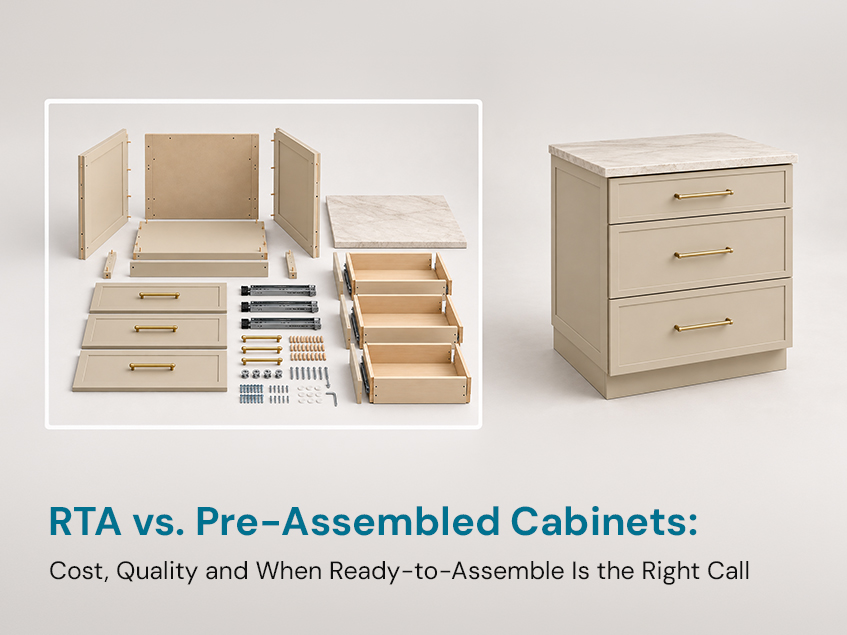
Here’s a pattern we see in the showroom all the time. Someone walks in with a kitchen quote that made them wince, and the first thing out of their mouth is, “What about the flat-pack ones? Are those any good?” It’s a fair question. Sometimes RTA is the smartest money you’ll spend on a remodel. Other times it’s a false economy. Which one it turns out to be depends on a few things you can figure out before you order anything.
What RTA and KD actually mean
RTA means ready-to-assemble. The cabinet arrives as a stack of flat panels, a bag of hardware and an instruction sheet, and somebody (you, a handyman, your installer) builds it where it’s going to live. KD, or knock-down, is the trade term for the same idea: a cabinet designed to come apart for shipping.
Pre-assembled cabinets are the opposite. They’re built at the factory and delivered as finished boxes, ready to hang. That’s the entire difference in delivery. It says nothing yet about how well either one is made, and that’s the part people tend to skip over.
The price gap exists for plain logistical reasons. A flat box takes up a fraction of the truck space, nobody at the plant is paid to assemble it, and fewer cabinets get dinged on the way to your driveway. You’re mostly paying less for shipping and labor, not necessarily for worse materials.
What each option costs
Prices move with door style, wood species, finish and where you live, so read this table as a rough planning guide rather than a quote. These figures cover cabinets only, with no countertops, hardware upgrades or installation.
| Cabinet type | Typical cost per linear foot | Where it fits best |
|---|---|---|
| RTA | $250 | Tight budgets, DIY projects, rentals |
| Pre-assembled stock | $350 | Faster turnaround, standard layouts |
| Semi-custom | $700 | Odd room sizes, wider finish choices |
Run those numbers across a 25-foot run of cabinets and the difference between RTA and semi-custom can pay for a new appliance, or even a countertop upgrade. If you’re building a full budget, our kitchen cabinet cost guide covers the rest of the line items people forget. And if you’d like to see what the budget end looks like in real life, start with our RTA cabinets.
How they’re built (and what to look for)
Plenty of people assume flat-pack means flimsy. In practice, the label tells you very little. These are the four places where one cabinet quietly beats another.
The box itself. Plywood handles humidity and repeated screw-ins better than anything else. Particleboard and MDF are cheaper and do fine in a dry pantry or laundry room, but a slow leak under a kitchen sink will make them swell and crumble. Whatever you’re considering, find out what the sides, bottom and shelves are made of, because manufacturers sometimes use different materials for different parts.
How the pieces connect. RTA boxes usually go together with cam-lock fasteners and wooden dowels. When the tolerances are tight and there’s a proper back panel, the result is rigid. Factory-built cabinets are typically glued and stapled or screwed, which is just as sound when done properly. A sloppy staple job is worse than a well-made cam-lock cabinet, so don’t assume the factory method wins by default.
The drawers. Look at the corners. Dovetail joints interlock like fingers and hold up to years of loaded pots and pans. Stapled corners can work loose. Soft-close glides, which used to be an upgrade, now come standard on a lot of lines in both categories, but check rather than assume.
The finish. The doors on many RTA and assembled lines come out of the same factory with the same coating, which means you may be getting an identical front for less. Ask how the finish is applied and how it handles moisture and cleaning, since the door takes the most abuse in any kitchen. Our write-up on what makes cabinets durable goes deeper on all of this.
The assembly reality check
You can build RTA cabinets with a drill, a screwdriver, a rubber mallet and a clear patch of floor. Plan on half an hour or so for a plain base cabinet, and more for corner units, pull-outs and tall pantries. For a typical kitchen with 15 to 20 boxes, a first-timer should expect a couple of weekends, not an afternoon.
Where the savings start to shrink:
- You’re paying someone else to build them. Assembly is billable time, and it eats into the price difference.
- Your layout is fussy. Angled walls, lots of fillers and tall appliance panels leave more room for mistakes.
- Your kitchen can’t be out of service for long. Two extra weekends without a sink has its own cost.
- Something arrives damaged or gets built wrong. A missing panel can stall the whole job while a replacement ships.
Then there’s installation, which is the real skill. Getting a run of cabinets level, plumb and tight to the wall takes patience, and shortcuts show up months later as doors that won’t line up. If that part worries you, our team handles installation too.
Warranty and replacements
Read the warranty before you buy, not after something breaks. Three questions are worth asking about any cabinet line:
- Does coverage still apply if you assembled it yourself? Some manufacturers cover it. Others require professional assembly or exclude anything tied to how it was built.
- What happens when a box arrives damaged? Open everything on delivery day, photograph problems and note them on the paperwork before the driver leaves.
- Can you buy one part instead of one whole cabinet? This is where RTA often shines. A cracked door or panel can frequently be reordered on its own. With assembled cabinets, replacing a single box can mean trying to match a finish from a batch that’s since been discontinued.
We keep each manufacturer’s warranty details available through the site, so you can compare lines side by side before committing.
Which route suits your situation
| If this sounds like you... | Consider | Why it works |
|---|---|---|
| Handy, budget-conscious, not in a hurry | RTA | Your time converts into real savings |
| Fixing up a property to sell or rent | RTA or pre-assembled stock | Costs stay predictable and sizes are standard |
| Staying in the house for decades | Semi-custom or pre-assembled | Sturdier build options and more sizing and finish choices |
| Managing rentals with frequent turnover | RTA | Swapping a single door or panel is cheap and quick |
| Working with an awkward floor plan | Semi-custom | Fewer fit headaches and more flexibility |
| Hate the thought of assembly | Pre-assembled | The factory does the tedious part |
You don’t have to pick one for the whole house, either. Plenty of homeowners put RTA in the laundry room, garage or guest bath and save their budget for a semi-custom kitchen. Bathrooms are especially forgiving because there are only a few boxes to put together, and our RTA bathroom vanities make a low-risk first project if you’ve never built cabinets before.
So, which one should you choose?
If you’re comfortable with some building, your layout is simple and keeping costs down is the top priority, RTA is a sensible choice. If you want sturdier construction, more sizing options or you’d rather not spend your weekends with an instruction sheet, pre-assembled or semi-custom is probably worth the extra money. Neither is the “better” cabinet in every case. The right answer comes from your room, your budget and how long you plan to live with the result.
Frequently Asked Questions
-
What does RTA stand for in cabinetry?
Ready-to-assemble. The cabinet ships flat in boxes and gets put together at your home or job site. You’ll also hear “KD” or knock-down, which describes the same thing.
-
Are RTA cabinets cheaper than pre-assembled ones?
Generally, yes. RTA often lands between $100 and $250 per linear foot, compared with $150 to $350 for assembled stock and $250 to $700 for semi-custom. Add assembly labor and the gap narrows, so compare the total installed price. Our kitchen cabinet cost guide can help you build the full picture.
-
Are RTA cabinets lower quality?
Not automatically. The materials, joinery, drawer construction and finish matter far more than whether the box showed up flat. A well-made RTA line can outlast a cheaply built assembled one. For a closer look at what to inspect, see what makes cabinets durable.
-
Are RTA cabinets plywood or particleboard?
You’ll find both. Plywood copes better with moisture and holds screws more securely, while particleboard and MDF keep costs down in dry spaces. For sink bases and bathrooms, plywood is the safer bet. Check the spec sheet for the sides, shelves and back panel.
-
How long does it take to put RTA cabinets together?
Around 20 to 40 minutes for a basic base cabinet if it’s your first time, longer for corners and pantries. A whole kitchen often takes a couple of weekends, plus time for leveling and installation.
-
Can I install RTA cabinets by myself?
You can if you’re comfortable with a drill, a level and a bit of patience. Installation is trickier than assembly because walls and floors are rarely perfectly flat. If your layout has lots of corners, hiring a professional installer is worth considering, and Kade Cabinet Co. offers installation across North Georgia.
-
When does the labor saving disappear?
When you hire someone to assemble the cabinets, when the layout is complicated, or when a damaged box delays everything. In those cases, assembled or semi-custom cabinets can end up being the better value.
-
Do RTA cabinets come with a warranty?
Most do, but the terms differ from line to line. Look at whether self-assembled cabinets are covered, how shipping damage is handled and whether individual parts can be replaced before you buy.
-
Can I replace just one damaged door or panel?
Often, yes. Many RTA lines sell parts separately, which keeps repairs inexpensive. That’s one reason RTA is popular with landlords and property investors. Availability depends on the line, so ask first.
-
Are RTA cabinets a good choice for bathroom vanities?
Yes. Fewer boxes mean easier assembly, so a vanity is a natural starter project. If the space gets steamy or splashy, look for water-resistant construction. You can see what we carry in our RTA bathroom vanities collection.
-
What’s better for a long-term home, RTA or semi-custom?
For a house you plan to keep, semi-custom usually gives you more room to adjust sizes, finishes and construction details. RTA still earns its place in secondary spaces like laundry rooms, garages and guest baths, and mixing the two is a common way to balance cost and longevity.
-
Does Kade Cabinet Co. sell RTA cabinets?
Yes. Our Cumming, GA showroom offers custom, semi-custom and ready-to-assemble cabinetry, along with RTA bathroom vanities. You can book a free kitchen design that includes a layout and 3D rendering, then compare RTA, assembled and semi-custom side by side. Start by browsing our RTA cabinets.
Want a second opinion before you buy?
Bring your measurements to our Cumming, GA showroom and we’ll price out the same kitchen three ways, so you can see exactly what you’d save with RTA and what you’d give up. Our free kitchen design includes a layout and 3D rendering at no initial cost. You can also look through our RTA cabinet range first and bring your favorites along.
Recent Articles
 15 October,2026
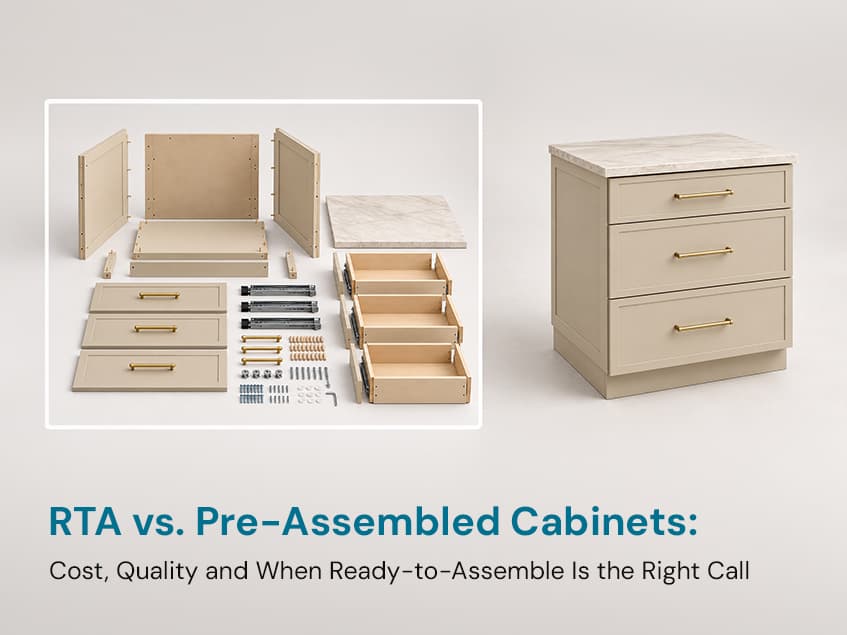
RTA vs. Pre-Assembled Cabinets: Cost, Quality and When Ready-to-Assemble Is the Right Call
Compare RTA vs. pre-assembled cabinets by cost, quality, and installation time to find the right option for your kitchen remodel or renovation project.
Read More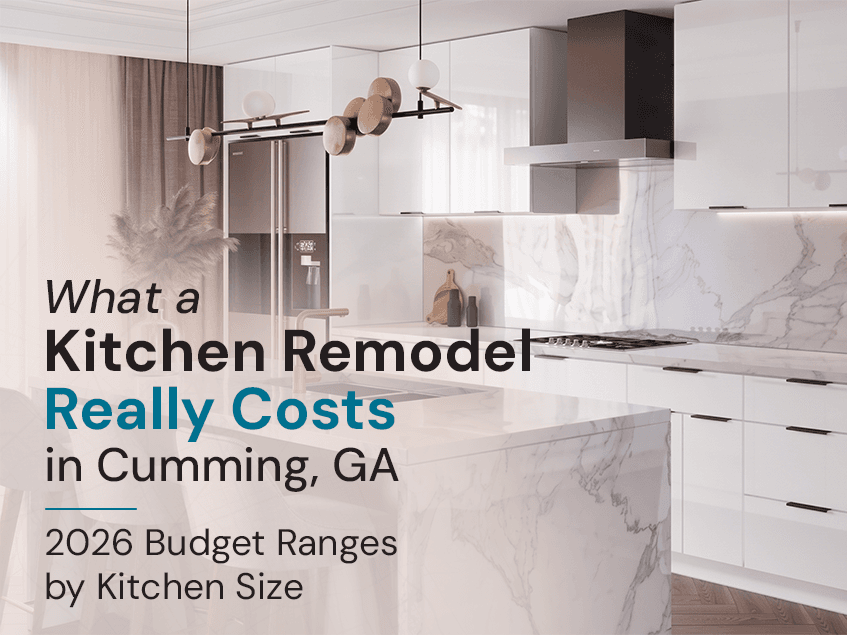 29 September,2026
What a Kitchen Remodel Really Costs in Cumming, GA - 2026 Budget
2026 kitchen remodel costs in Cumming, GA by kitchen size, plus refacing vs. replacing, Forsyth County permits, lead times and what moves your budget.
Read More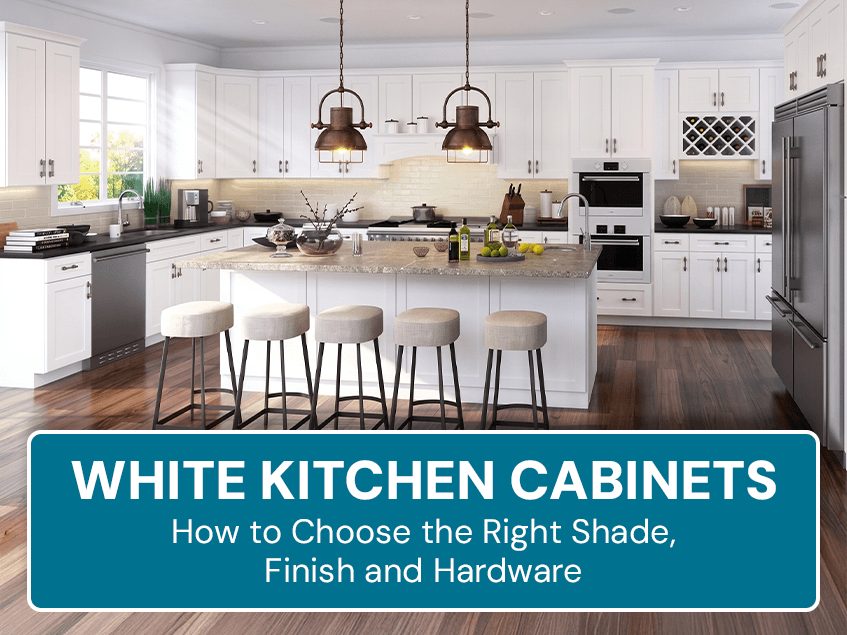 15 September,2026
White Kitchen Cabinets: How to Choose the Right Shade, Finish and Hardware
Learn how to choose white kitchen cabinets by comparing shades, finishes and hardware to create a cohesive, functional kitchen design.
Read More